聊天讨论 The Team Behind Palaura Spent 13 Years Building Dating Apps — Now They're Betting AI Can Fix Matchmaking

After 13 years of building dating and relationship apps, Palaura's founders say the category's central problem — matching people well — remains unsolved. Their answer, now live across the United States, is an AI matchmaker that works over iMessage.
"We started Palaura because matching people well is still way too hard, and we think AI can finally make it simple," the company says of its origin. "It's the matchmaker we always wanted to build."
Coming from a first-time founder, that statement would read as standard startup positioning. Coming from this team, it reads closer to a verdict. By the company's own account, Palaura's founders have built dating and relationship apps together for over 13 years. Their previous apps, the company says, helped more than 60 million couples, average a 4.8-star user rating, and one reached No. 5 on the App Store's Lifestyle charts in multiple countries. These are not outsiders diagnosing an industry from a distance; they are veterans of it, asserting that after more than a decade of building inside the category, its central problem — reliably matching people well — has still not been solved.
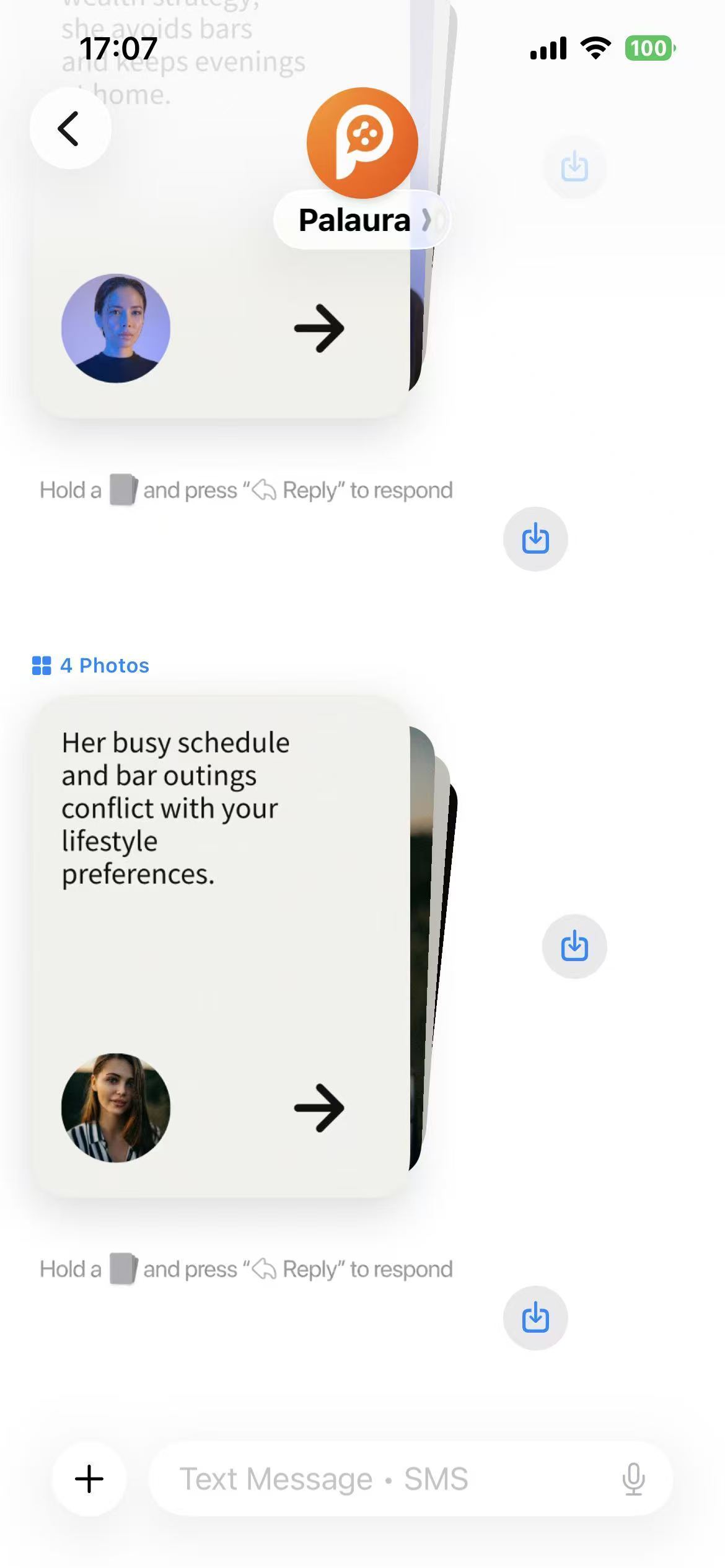
Their answer arrived this summer, and it looks very little like the products the industry spent those years refining. Palaura, built by a startup for the US market, is an AI matchmaker that lives in the user's iMessage thread: nothing to install, no directory of faces to browse, and the swipe gone entirely. Users text with an AI the company refers to as "her," who interviews them at length, curates a small number of introductions, and connects two people only after both have independently agreed.

An industry that grew without solving its problem
Online dating hardly needs an introduction anymore, least of all among the young: 53 percent of US adults under 30 have used a dating site or app, according to a 2023 Pew Research Center report. Nor is the intent casual. The same report found that 44 percent of recent users cited finding a long-term partner as a major reason they signed up — more than named any other motivation.
Satisfaction, however, has not kept pace with adoption. Pew's research found users roughly divided on whether online dating had been good for them at all, and it documented a now-familiar asymmetry in the frustration: women who use the platforms disproportionately describe being overwhelmed by the volume of attention they receive, while men disproportionately describe receiving too little.
Together, those findings sketch a category that is enormous and weary at the same time: adoption is broad, many users arrive looking for something serious, and yet a meaningful share of them experience the core activity — browsing, evaluating, messaging, repeating — as an exercise in fatigue.
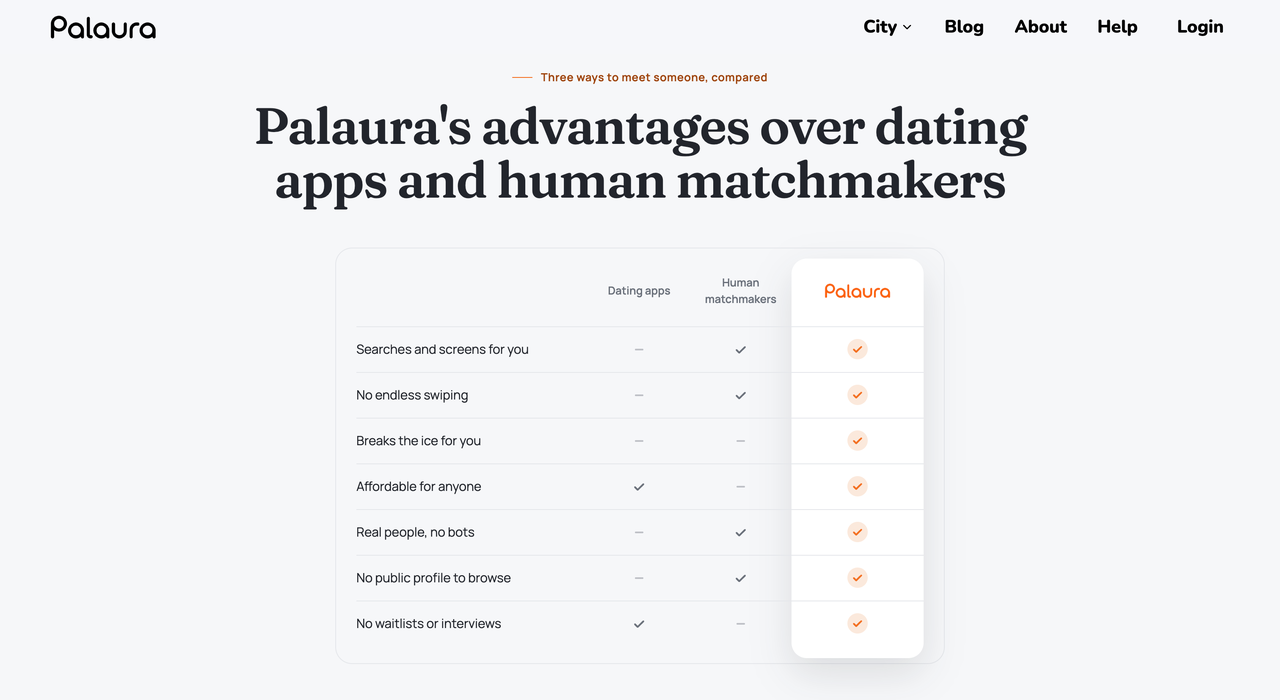
Palaura's design implies a diagnosis that locates the cause in the architecture rather than the execution. Mainstream dating apps are built around browsing: the user is presented with an inventory of profiles and does the work of searching through it. That design scales extraordinarily well, which is why it won the market. But it also means the product's fundamental unit is the profile view, not the successful match, and the person doing the matching — sorting hundreds of strangers on limited information — is an untrained user working alone.
The alternative has always existed. Human matchmakers do what browsing cannot: they interview clients in depth, screen candidates personally, and make a small number of considered introductions. The limitation is arithmetic. A human matchmaker's hours do not scale, so personal matchmaking has traditionally been priced as a luxury service, out of reach for most of the people the mainstream apps serve.
That is the gap Palaura is aimed at: the mass market gets browsing, personalized matchmaking is priced out of reach, and the middle — thoughtful, individualized matching at consumer prices — has stayed empty because no one could staff it. The company has not published this analysis in so many words, but it is the plainest reading of its stated founding motive — that "matching people well is still way too hard" — coming from a team with 13 years inside the category.
Why the company believes the math changed The founders' bet is that artificial intelligence has now changed the arithmetic that kept that middle empty. Over the past few years, AI systems have become capable of holding extended, natural conversations by voice, retaining what a person said across weeks of contact, and producing reasoning that a human can read and evaluate. Those three capabilities map directly onto the three expensive components of human matchmaking: the intake interview, the ongoing relationship with the client, and the judgment call about who should meet whom — along with the ability to explain that judgment. If software can do that work credibly, the labor cost that made matchmaking a luxury service largely disappears, and the format becomes viable at consumer prices. That is the entire premise of the company. Palaura describes its product as "an AI matchmaker on iMessage that matches on your values — for people who are serious about finding the one." The choice of iMessage as the venue follows from the same logic. A matchmaker is someone you talk to, not an inventory you browse, so Palaura made the product a contact in the user's existing text messages rather than a destination requiring a download. The company's positioning leans on the relationship framing throughout: "She gets to know you, learns who you're looking for, and introduces you when there's a real fit."
What they built
The product itself, live across the US anywhere iMessage can be used, compresses a matchmaker's working method into software, and for the purposes of the company's story it can be described briefly. Joining runs through https://heypalaura.com/: a short signup for adults 18 and over, a voice interview of about 15 to 20 minutes with the AI (a written Q&A is available for those who would rather not talk), at least two photos, and a profile the user reviews and confirms before anything is shared — then a single pre-filled text connects iMessage. From there the pace is deliberately scarce: at most a few screened, curated introductions a day, arriving as photo cards in the user's texts, and before any connection is made, the two people's AI agents compare notes across seven compatibility dimensions, each user can read back how their own agent represented them and coach it if it got things wrong, and nothing moves forward without a yes from both sides — with early messages relayed by Palaura so phone numbers stay private until both people are ready.
For a story about the company, the more revealing details are the commitments wrapped around that machinery — the places where a team that spent 13 years living with the category's engagement incentives chose to cut against them.
The first is an honesty rule. The company commits that its AI never fabricates an introduction: anyone Palaura puts forward is, by its stated policy, a real person who is actively looking to meet someone. When Palaura has no strong candidate for a user, the company says, the AI admits as much and stays in touch rather than padding the results — a policy that trades short-term activity for credibility.
The second is a set of privacy and safety commitments. The company states, "We never sell your data or train on it" — meaning personal data is not used to train AI models — and users can text STOP at any time to have everything erased. The service is restricted to adults 18 and over, blocks contact information in bios, and presents itself as open to anyone seeking a real connection, LGBTQ+ users explicitly included. Sensitive attributes such as faith, politics, and intentions around children inform the matching itself but are never disclosed in the reasons shown to the other side.
The business model is freemium. In the company's words, "the basics are free. You only pay for premium features," with premium "priced to stay affordable" — a pricing posture consistent with the founding argument that personalized matchmaking should not be a luxury good.
The company on paper
Behind the conversational product is a startup building specifically for the American market, where the product made its public debut this summer. A US trademark application for "Palaura" has been filed with the United States Patent and Trademark Office, a matter of public record, and signup runs through the company's site, heypalaura.com.
The trademark filing signals an intent to build a durable American consumer brand rather than run a short experiment.
An unproven bet, made by people who know the odds
None of the company's history guarantees the bet pays off. The claim at the center of Palaura — that an AI can interview a person well enough, and reason about compatibility well enough, to make introductions that beat what browsing produces — is testable, and the test has barely begun. The product went live this summer; its results will take longer than a summer to read.
The company has also chosen constraints that make the bet harder in the short term. An AI matchmaker that refuses to invent matches, and that tells users when it has nothing good for them yet, forgoes the mechanisms that keep browsing products busy. A few introductions a day, gated by mutual consent, is a deliberately slow cadence in a category that has monetized speed.
But that trade is the point. The founders spent 13 years building inside the category, and their conclusion, in their own words, is that "matching people well is still way too hard." Palaura is the version of the product they believe was impossible until now — and the next year will show whether the technology has actually caught up to the ambition.